Advertorial · Sponsored feature · Advertising policy
Sharper Mind DailyNotes on a sharper mind
Mind & Memory
Field Essay · November 2026
Field Essay · 7 min read

Imagine Tracking Planes From Memory for 38 Years. Then Your Own Grandkids’ Names Slip Away. Could a 12-Minute Sound Help?

A dozen call-signs, altitudes and headings in your head at once, never a note. Now picture retirement, and the little details starting to vanish. Here’s what the research says about memory and rhythm, and what to make of a 12-minute audio called The Brain Song.

An older couple walking arm in arm along a tree-lined path beside a lake
A whole career of trusting your mind doesn’t prepare you for the day it starts dropping the small things.

Think about what that job asks of a person. A dozen aircraft at once, every call-sign, altitude and heading held in working memory, with no time to reach for a note. Now picture that same person years later, standing in their own kitchen, looking right at the kettle, and the word won’t come. What they feel isn’t annoyance. It’s closer to fear.

It usually builds slowly. A name gone the second you reach for it. A walk into a room with no idea why. A heavy, underwater haze by mid-afternoon that coffee can’t touch. Everyone says it’s just what happens past sixty, and often they’re right: the National Institute on Aging says mild forgetfulness is frequently a normal part of getting older.1

But anyone who spent a career watching a screen for the faintest change wouldn’t wave it off without a closer look. A change you’ve noticed is worth paying attention to.

1 in 10
U.S. adults aged 45 and older reported worsening or more frequent confusion or memory loss in CDC survey data from 2015 to 2020. Fewer than half of them had talked to a health professional about it.2

01 When the word won’t come

Researchers have a name for that maddening feeling of knowing a word and not being able to reach it: a tip-of-the-tongue state. These moments are known to become more frequent as adults get older.3

Read about how memory holds up with age and one term keeps coming up: BDNF.

Short for brain-derived neurotrophic factor, BDNF is a molecule sometimes nicknamed “fertilizer for the brain.” It plays a part in forming new neurons in the hippocampus, a key memory region.4

So what helps? Exercise has real data behind it. In a randomized trial of 120 older adults, aerobic exercise grew part of the hippocampus by 2% and improved spatial memory, and the growth went along with higher BDNF levels.4 The NIA’s own list adds a daily routine, seven to eight hours of sleep and staying active and social.1

And then there’s a stranger line of research, one that looks at a particular brainwave rhythm. A frequency. Gamma waves.

A frequency. The idea that memory might have something to do with rhythm, and not only chemistry, is hard to shake once you’ve heard it. Especially after a lifetime of watching for the smallest shift on a screen.

02 What the research actually shows

It’s less fringe than it sounds. Scientists have long studied how groups of brain cells fire together in waves: slow ones roll through deep sleep,5 and gamma waves are much faster, at roughly 20 to 50 cycles per second.6 In mice bred to develop Alzheimer’s-like changes, gamma rhythms weakened early on,6 and seven days of 40 Hz tones improved their spatial and recognition memory.7

In people, the evidence is much earlier. In a small placebo-controlled pilot with 15 people with mild Alzheimer’s, a dedicated light-and-sound device was used every day for three months. It was well tolerated, the active group did better on a delayed-recall test, and the authors call for a larger trial.8 Separately, a meta-analysis of 22 studies on binaural beats found a medium-sized effect across memory, attention, anxiety and pain, depending on the frequency, the timing and how long people listened.9

The core idea. Groups of neurons fire in step, and different mental states ride on different frequencies. Give the brain a steady rhythm from outside, through light or sound, and its own activity can fall into step with it.8 Whether a home audio track can do the same, and whether that helps memory, is still an open question. What’s on offer here isn’t a drug or a device. It’s sound, arranged on purpose and listened to for a few minutes a day.

That’s the principle behind The Brain Song, a 12-minute digital audio credited to a company called Neural Revive. No clinic, no prescription. The seller says it uses advanced sound patterns to gently guide the brain toward gamma frequencies.

Skepticism is fair. Plenty of “miracle” sounds have come and gone. But the ask is small: nothing to swallow, nothing to remember to take. You press play and listen.

03 How a “song” is supposed to work

Here’s a picture that helps. Think of a crowd clapping. Nobody gives a signal, yet after a few seconds the hands fall into the same beat. The brain does something loosely similar with rhythm: give it a steady, well-built pattern of sound, and its electrical activity can lean toward that pattern. Researchers call it entrainment.7

A 12-Minute Daily Listen The whole routine
One short track, once a day, in the comfort of your own home. That’s the seller’s whole routine: no app to figure out and no schedule to track.
Digital audio · delivered online
Gamma-Range Sound Patterns
According to the seller, the audio uses advanced sound patterns to gently guide the brain toward gamma frequencies, the fast rhythms in the research above.
As described by the seller
The BDNF Connection “Fertilizer for the brain”
The seller points to research suggesting gamma brainwaves may play a role in encouraging BDNF activity. That link is still early science.
Early research
Nothing to Swallow, Nothing to Ship
It’s an audio, so there’s no pill to remember and no package to wait for. Find a quiet spot, keep the volume comfortable and make it part of your day.
Enjoyed in the comfort of home
Editorial note. The Brain Song is a wellness audio program, not a medical treatment, and it isn’t intended to diagnose, treat, cure or prevent any disease. If you have epilepsy, tinnitus or another hearing condition, ask your doctor before trying it. If you notice significant or sudden changes in memory or thinking, please talk with a qualified healthcare provider.

04 Your first three weeks

You don’t have to take anyone’s word for this. If you try it, run it the way a controller would: same time every day, twelve minutes, and notes.

Log · Week 1

Set the routine. Note whether it feels pleasant or like one more chore. It’s far too soon to call it anything, so just write it down.

Log · Week 2

Watch your afternoons. Does that two o’clock fog settle in the way it normally does? It could be sleep or the weather as much as the sound. Note it either way.

Log · Week 3

Keep score on the small stuff. A name that came right away, a word that didn’t. Ask someone close to you whether they’ve noticed anything, without telling them why.

Be careful what you conclude. Three weeks is only three weeks, and nobody can promise what you’ll notice. But the routine costs twelve quiet minutes a day, and you have 90 days to decide whether it’s worth keeping.
You’re not looking for a miracle. You’re looking for a small signal, the way a controller watches a quiet screen.
Before you buy. None of the studies above tested The Brain Song, and we found no published study of it. The human 40 Hz pilot used a dedicated light-and-sound device, not an audio track. You also won’t find testimonials here: we couldn’t verify any, so we didn’t print any. The National Institute on Aging urges caution with products that claim to make the brain sharper or prevent dementia, and suggests talking with your doctor before buying.1 Our take: a low-cost experiment, not a treatment.
Featured in this essayDigital · instant access
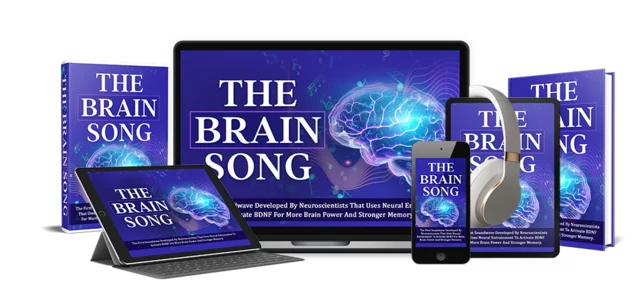
The Brain Song cover shown on a laptop, tablet and phone

The Brain Song: A 12-Minute Daily Listening Routine

Digital audio · sold through ClickBank

A simple 12-minute digital audio from Neural Revive, built on sound patterns the seller says guide the brain toward gamma frequencies. Immediate access after checkout, backed by a 90-day money-back guarantee (terms apply).

$39 / one-time payment
Immediate access after checkout
Get The Brain Song Here
Digital audio program · results vary · 90-day money-back guarantee (terms apply)
Delivered digitally; devices and headphones not included. Price as shown at checkout on Nov. 7, 2026.
🎧 12 minutes a day⚡ Immediate access↩ 90-day guarantee💳 One-time payment

Background & further reading

  1. Memory Problems, Forgetfulness, and AgingNational Institute on Aging · nia.nih.gov
  2. Racial and ethnic differences in subjective cognitive decline, United States, 2015–2020Wooten KG, et al. MMWR. 2023;72(10):249–255 · PubMed 36893045
  3. Age-related changes in word retrieval vary by self-reported anxiety but not depression symptomsShafto MA, et al. Aging Neuropsychol Cogn. 2019;26(5):767–780 · PubMed 30282517
  4. Exercise training increases size of hippocampus and improves memoryErickson KI, et al. Proc Natl Acad Sci U S A. 2011;108(7):3017–3022 · PubMed 21282661
  5. Auditory closed-loop stimulation of the sleep slow oscillation enhances memoryNgo HV, et al. Neuron. 2013;78(3):545–553 · PubMed 23583623
  6. Gamma frequency entrainment attenuates amyloid load and modifies microgliaIaccarino HF, et al. Nature. 2016;540(7632):230–235 · PubMed 27929004
  7. Multi-sensory gamma stimulation ameliorates Alzheimer’s-associated pathology and improves cognitionMartorell AJ, et al. Cell. 2019;177(2):256–271.e22 · PubMed 30879788
  8. Gamma frequency sensory stimulation in mild probable Alzheimer’s dementia patients: results of feasibility and pilot studiesChan D, et al. PLoS One. 2022;17(12):e0278412 · PubMed 36454969
  9. Efficacy of binaural auditory beats in cognition, anxiety, and pain perception: a meta-analysisGarcia-Argibay M, et al. Psychol Res. 2019;83(2):357–372 · PubMed 30073406
Questions worth asking
Before you decide
What exactly do I get?

A 12-minute digital audio with immediate access after checkout. Nothing is shipped.

How do I use it?

The seller describes a simple 12-minute daily routine you can do at home. Find a quiet, comfortable spot and keep the volume at a comfortable level.

Is it a subscription?

No. Checkout shows a single $39 charge for a digital product.

What if it isn’t for me?

The seller offers a 90-day money-back guarantee (terms apply), and ClickBank, the retailer, allows returns within 90 days of purchase.

Will it fix my memory?

We can’t promise that, and neither can anyone honest. It’s a wellness audio, not a medical treatment. If changes in your memory worry you, talk with your doctor.

Get The Brain Song Here